The intelligence layer

Source-cited clinical AI you can verify.

Most healthcare “AI” points a language model at a chart and hands you a summary. Cascala is built the opposite way: a clinical intelligence layer that reasons above the source documents, cites every claim back to the record, and produces a verifiable, audit defensible trail. Every protocol is written and reviewed by our clinical team.
Source-cited by default
Verifiable, audit defensible
Configurable clinical knowledge bases
Built & reviewed by clinicians
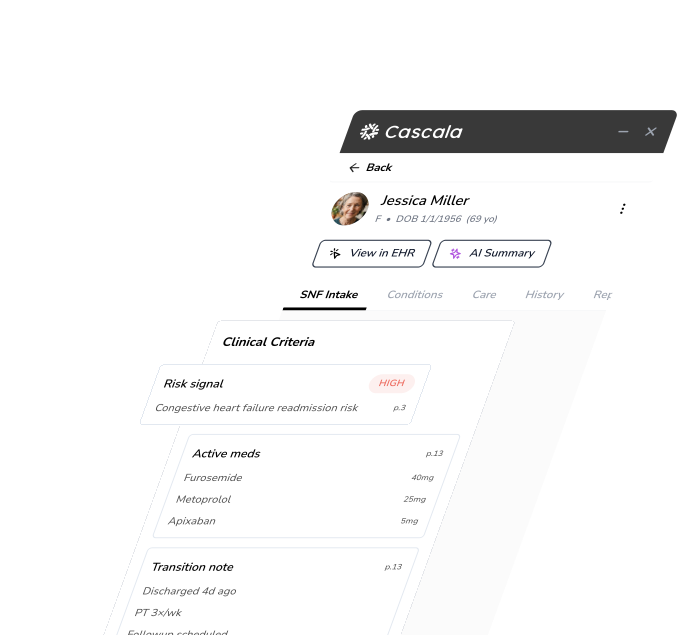

A clinical intelligence layer that lives above the record.

Summarization tells you what a document says. Cascala connects information across the record to surface what matters, what’s at risk, and what to do next.
Reasoning across sources
Connects diagnoses, medications, labs, and transition signals to identify risks and gaps—not just restate notes.
Clinical knowledge, applied
Turns source documentation into clear, patient-specific insights and next steps.
Clinician-authored logic
Built on protocols developed and reviewed by clinicians and our medical advisory board.
A demonstration of how to use the clinical intelligence of Cascala Health.

How Cascala helps

Every claim traces back to the source.

In risk-bearing and post-acute settings, an insight you can’t defend is a liability. Cascala is built so everything it surfaces carries its evidence with it — ready for a coder, a clinician, or an auditor.

Source-cited extractions

Every insight links to the exact document and location — e.g. ‘re-admit risk: High — source: Discharge Summary p.3.’ Nothing is asserted without a citation.

Audit-defensible documentation

Suspected conditions and HCCs surface with the source evidence attached, supporting clean, auditable coding that stands up to audit review.

Built for the latest requirements

Extractions and recapture logic align to the current risk-adjustment model — defensible at the moment it’s created, not reconstructed later.

A record across every setting

The audit trail follows the patient across hospital, SNF, home health, and PCP — one reconcilable evidence base for shared savings and star ratings.
Medical professionals discussing medical records.

Your standards of care, wired in.

The clinical knowledge layer is configurable. Cascala can reason against the evidence sources your clinicians already trust — so outputs reflect your standard of care, not a generic model’s.
Clinical evidence base
Recommendations reflect current, cited clinical literature.
Physician reviewed protocols
Rigorous approach to ensuring all workflows actually match how care is delivered.
Client-configurable
Bring the knowledge bases and protocols your clinical leadership chooses — the layer adapts to your standard, and every output stays cited to its evidence.
98%
clinical extraction accuracy
0
observed critical errors or hallucinations in >250k unique extractions
2%
of extractions flagged in human review — none critical

Accuracy we measure, not accuracy we claim.

In human review, only 2% of extractions were flagged for potential improvement — none involving critical clinical errors or fabricated clinical information. Because every extraction is source-cited, a reviewer can verify any claim against the original record in seconds.
Human-in-the-loop review
Extractions are reviewed against the source, so accuracy is measured against ground truth — not self-reported by the model.
No fabricated clinical information
Across reviewed extractions, zero critical clinical errors and zero hallucinated clinical facts were observed.
Verifiable, not just accurate
Source citations make every output checkable — the accuracy figure is auditable, not a marketing number.

Frequently Asked Questions

Is Cascala an AI chatbot for healthcare?

No. Cascala is a workflow-centered clinical intelligence platform, not a general-purpose chatbot. Its clinical protocols are developed by Cascala’s clinical team, and surfaced information is traceable to its original source.

Does Cascala replace clinical judgment?

No. Cascala supports healthcare professionals by organizing information, surfacing relevant context, and linking insights to source documentation. Clinicians remain responsible for reviewing the evidence and making care decisions.

How does Cascala make clinical insights traceable?

Cascala links surfaced clinical information back to its original source documentation. Care teams can review the supporting evidence behind an insight instead of relying on an unsupported AI-generated statement.

What is source-cited clinical intelligence?

Source-cited clinical intelligence organizes relevant information from available records and connects each surfaced insight to the documentation that supports it. This gives clinicians a faster way to understand the clinical picture while keeping the underlying evidence visible.

Demo item 1 — the question field renders here

The answer rich-text field renders here. This stand-in exists only so the local file has something to open and close.

Demo item 2 — a longer question, to show how the text wraps next to the icon on narrow screens

Rich text can hold several paragraphs.

A second paragraph, then a list and a link, to preview how answer formatting is styled:

  • First list item
  • Second list item

A link inside an answer

Demo item 3

Stand-in answer.

Demo item 4

Stand-in answer.

Responsible by design

This is not an AI chatbot pointed at a patient record.

Every protocol was written by our clinical team. Every extraction is traceable to its source. Our medical advisory board — medical directors from UNC Health, Equality Health, Oak Street, and beyond — reviews the logic that governs what Cascala surfaces. That’s the difference between an AI experiment and clinical intelligence you can stand behind.

See the evidence behind every insignt.

Twenty minutes is all it takes to see what better intelligence does for better outcomes.
© 2026 Cascala Health, Inc. All rights reserved.

Cookie Notice

We use cookies to ensure that we give you the best experience on our website. You can manage your preferences at any time.